Progressivism: A Primer on the Idea Destroying America by James Ostrowski
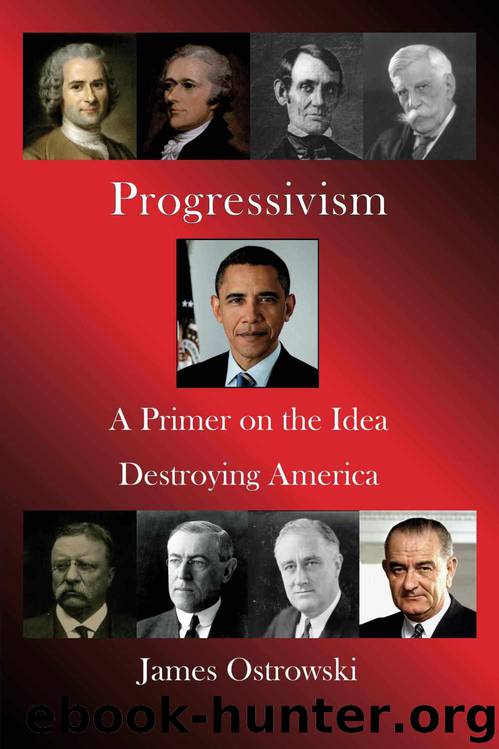
Author:James Ostrowski [Ostrowski, James]
Language: eng
Format: epub
Publisher: Cazenovia Books
Published: 0101-01-01T00:00:00+00:00
“Among the twelve million people living in the United States, there is not one single man who has dared to suggest restricting the freedom of the press."[141]
Just twenty-five years later, Lincoln, true to his Federalist and Hamiltonian[142] roots, felt no compunction whatever about jailing during the Civil War a total of thirteen thousand civilians who had expressed pro-Southern views. According to historian Arthur Ekirch, this was often done "without any sort of trial or after only cursory hearings before a military tribunal."[143]
Another twist on the Lincoln-Jefferson dichotomy is their respective positions on habeas corpus. Jefferson complained that the "eternal and unremitting force of the habeas corpus laws" was not protected in the new Constitution. Lincoln in contrast, illegally suspended habeas corpus during the Civil War and simply ignored an order by the Chief Judge of the Supreme Court to release a political prisoner. Franklin Roosevelt also showed callous disregard of habeas corpus by imprisoning Japanese-Americans during World War II with the approval of a thoroughly progressive Supreme Court.
The next time free speech was challenged during wartime was World War I. During that war, run by a progressive president, Woodrow Wilson, Congress passed the Espionage Act of 1917, which forbade among other things, promoting insubordination or refusal of duty among the armed forces. Three persons convicted under this Act appealed their convictions to the Supreme Court, arguing that their activities were privileged and shielded from prosecution by the First Amendment. In these cases, the illegal behavior consisted of publishing a pamphlet opposing the draft, publishing a pamphlet sympathetic to Germany, and speaking out in favor of socialism.
Had the three defendants, including Eugene V. Debs, been judged by a Supreme Court sympathetic to the natural human right of free speech, their convictions would certainly have been overturned. History, however, played a cruel trick on them. The judge assigned to write the opinions of the court in all three cases was thoroughly Hamiltonian and progressive and was the most vociferous critic of natural rights theory America has ever seen―Oliver Wendell Holmes.
Holmes had nothing but scorn for the man who first insisted that a free speech amendment be added to the Constitution: Thomas Jefferson. On the one hundredth anniversary of John Marshall taking the bench as chief judge of the Supreme Court, 1901, Holmes made reference to Jefferson's political enemy and cousin. He spoke of:
Download
This site does not store any files on its server. We only index and link to content provided by other sites. Please contact the content providers to delete copyright contents if any and email us, we'll remove relevant links or contents immediately.
| Anarchism | Communism & Socialism |
| Conservatism & Liberalism | Democracy |
| Fascism | Libertarianism |
| Nationalism | Radicalism |
| Utopian |
The Secret History by Donna Tartt(19034)
The Social Justice Warrior Handbook by Lisa De Pasquale(12183)
Thirteen Reasons Why by Jay Asher(8885)
This Is How You Lose Her by Junot Diaz(6873)
Weapons of Math Destruction by Cathy O'Neil(6261)
Zero to One by Peter Thiel(5784)
Beartown by Fredrik Backman(5734)
The Myth of the Strong Leader by Archie Brown(5495)
The Fire Next Time by James Baldwin(5426)
How Democracies Die by Steven Levitsky & Daniel Ziblatt(5211)
Promise Me, Dad by Joe Biden(5141)
Stone's Rules by Roger Stone(5080)
A Higher Loyalty: Truth, Lies, and Leadership by James Comey(4947)
100 Deadly Skills by Clint Emerson(4915)
Rise and Kill First by Ronen Bergman(4776)
Secrecy World by Jake Bernstein(4739)
The David Icke Guide to the Global Conspiracy (and how to end it) by David Icke(4697)
The Farm by Tom Rob Smith(4501)
The Doomsday Machine by Daniel Ellsberg(4482)
